

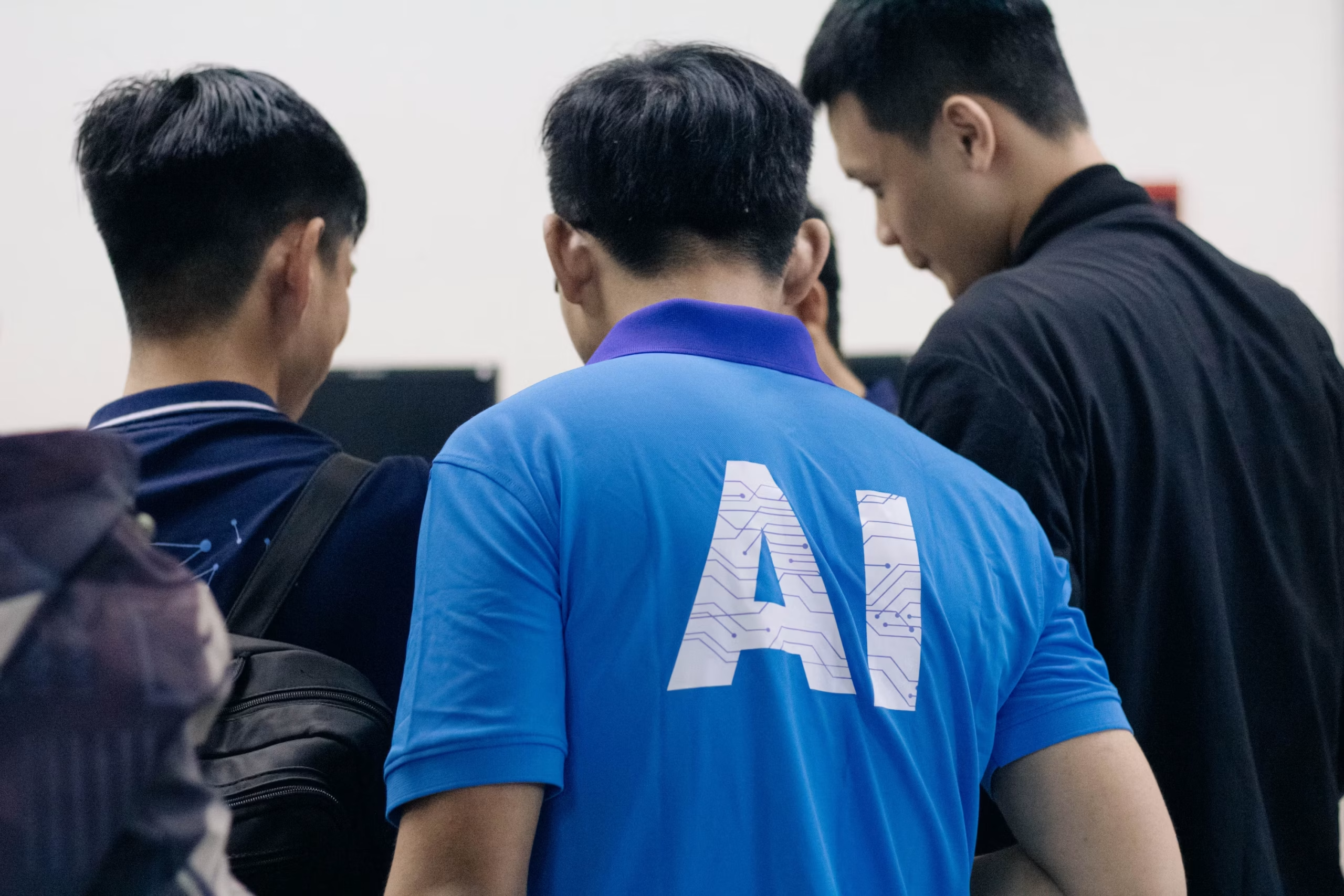
AI in Engineering: Amplifier, Not Solution
Artificial intelligence has moved from experimentation to expectation. In many engineering environments, AI tools are no longer optional — they are being embedded into workflows, development cycles, and decision processes at increasing speed.
The promise is clear: faster coding, automated testing, reduced effort, increased productivity.
But beneath that promise lies a structural reality that is often underestimated. AI does not introduce quality, clarity, or discipline into a system. It accelerates what is already there.
And what is already there varies more than most organisations are willing to acknowledge.
Acceleration Without Structure
In well-structured engineering environments, AI tools can create measurable gains. Code generation becomes faster because standards are already defined. Automated suggestions are useful because architectural principles are consistent. Testing improves because there is an existing culture of quality.
In these contexts, AI integrates into a system that already knows how to operate.
The result is amplification of competence.
However, in environments where systems are less defined — where ownership is unclear, standards are inconsistent, and decision-making is fragmented — the same tools behave differently.
They still accelerate.
But what they accelerate is variability.
Code is produced faster, but not necessarily better. Decisions are made more quickly, but without stronger foundations. Technical debt accumulates at a higher pace, often unnoticed until it begins to affect delivery.
The system moves faster.
The quality does not follow.
The Illusion of Productivity
One of the most immediate effects of AI adoption is the perception of increased productivity. More output is generated in less time. Tasks that once required significant effort can now be completed with fewer steps.
From a surface perspective, this appears as progress.
But productivity in engineering is not measured by volume alone. It is measured by the sustainability of what is produced — how well systems hold over time, how easily they can be maintained, and how reliably they support evolving requirements.
When AI is introduced into environments without strong engineering discipline, it often creates a gap between perceived productivity and actual system health.
More code is written.
More features are released.
But underlying complexity increases faster than the organisation’s ability to manage it.
This gap is where risk begins to accumulate.
Decision-Making Under AI Influence
AI is not only changing how code is written. It is also influencing how decisions are made.
Engineers rely on AI-generated suggestions. Teams incorporate automated reasoning into their workflows. In some cases, decisions that would previously require discussion are accepted based on AI outputs.
This introduces a subtle but important shift.
Decision-making becomes faster, but not necessarily more deliberate.
The risk is not in using AI as support. The risk emerges when AI replaces the need for structured thinking, architectural reasoning, and contextual understanding.
Because AI operates on patterns.
And patterns do not always reflect the specific constraints of a system.
Without strong internal validation, organisations begin to adopt decisions that are technically plausible but contextually misaligned.
Over time, this leads to systems that are harder to maintain, harder to scale, and harder to correct.
AI and the Amplification of Technical Debt
Technical debt has always been part of engineering. It emerges when short-term decisions are prioritised over long-term structure.
AI changes the speed at which this debt is created.
In environments with weak governance, developers can produce more code in less time, often without fully understanding the implications. Patterns are reused without context. Solutions are applied without validation.
What previously accumulated gradually can now grow exponentially.
And because AI-generated outputs often appear correct, the debt is less visible in its early stages.
It is only when systems begin to fail — through performance issues, integration problems, or increased maintenance effort — that the impact becomes clear.
By then, correction is significantly more complex.
The Role of Engineering Discipline
The difference between organisations that benefit from AI and those that struggle with it is not access to tools. It is the presence of engineering discipline.
This includes:
- clearly defined architectural principles
- consistent coding standards
- structured testing practices
- explicit ownership of systems and components
- decision frameworks that guide trade-offs
These elements create a system capable of absorbing acceleration without losing coherence.
AI becomes a multiplier of existing strength.
Without them, AI becomes a multiplier of inconsistency.
AI as a System Variable
Treating AI as a feature or tool limits its impact. In reality, AI should be understood as a system variable — something that changes how work is produced, how decisions are made, and how systems evolve over time.
Introducing AI into an organisation is not only a technical decision. It is an operational one.
It affects:
- the pace of development
- the distribution of knowledge
- the visibility of decision-making
- the balance between speed and control
Organisations that recognise this treat AI adoption as a structural change. They adjust processes, reinforce standards, and redefine how teams operate.
Those that do not often experience short-term gains followed by long-term instability.
Building AI-Ready Engineering Environments
Preparing for AI is less about selecting the right tools and more about strengthening the system into which those tools will be introduced.
This means investing in:
- clarity of architecture
- consistency of practices
- alignment across teams
- ownership of decisions
- visibility of system behaviour
When these elements are in place, AI can accelerate delivery without degrading quality.
When they are not, AI accelerates the emergence of existing weaknesses.
What Holds Over Time
In 2026, AI adoption is no longer a differentiator. It is a baseline expectation. The difference between organisations will not be who uses AI, but how it is integrated.
The organisations that sustain performance will be those that understand a simple principle:
AI does not improve systems by itself.
It reveals their structure — and amplifies it.
What holds over time is not the tool.
It is the system around it.


Deixe um comentário